You paid for the personalized tier. The reading sounded nice. Then a friend with the same sign showed you theirs, and it was the same reading.
This is the #1 complaint across astrology apps, and it's almost always justified. Most top-rated apps serve identical readings to users with wildly different birth times -- the friend-swap test below will show you. "Personalized" is doing a lot of work in the App Store descriptions. It usually doesn't mean what you think.
The Short Answer
A personalized horoscope app uses your exact birth time and location to calculate where the planets were at your birth, where they are now, and how the two charts interact. Most apps collect that data and then generate a Sun-sign reading anyway. The four tests below sort honest from fake in five minutes.
(One thing to get out of the way: our own free tier is also generic Sun-sign content -- same reading for every Capricorn that morning. Most apps' free tiers are. The honest personalization happens at paid tiers, for us and for everyone else. Keep reading.)
Four Tests to Tell If a Horoscope App Is Personalized
Test 1: Did setup ask for your birth time and place?
If it only wanted your birthday, the app is Sun-sign-only -- every 30-day window gets the same reading, cycling through twelve paragraphs on a schedule. If setup asked for exact time and birth city, that's necessary but not sufficient. Plenty of apps collect your birth time for a chart you can look at on a profile screen, then write your daily reading from your Sun sign anyway. The next three tests catch them.
Test 2: Does today's reading name specific placements?
Open your reading. Look for phrases like "your Moon in Scorpio," "Mars in your 7th house," "Venus squaring your natal Jupiter." If it mentions your Moon sign, your Rising sign, or specific houses, you're getting chart-based content. If it just says "As a Gemini..." and talks about communication because Gemini rules the 3rd house, you're reading a Sun sign paragraph with lighting.
Test 3: Swap with a friend who shares your sign.
The fastest test anyone can run. Find a friend with the same Sun sign but a different birth time and city. Screenshot your reading, have them screenshot theirs, compare. Identical? That's the smoking gun. Different -- meaningfully different, not just three words rearranged -- and something in there is using your chart.
Test 4: Do readings shift in meaningful ways day to day?
Personalized content changes when transits hit your chart. A Venus return feels different from a neutral Tuesday. If every morning reads like the same paragraph with three words swapped, the personalization is thin -- probably a small content library cycling on a schedule, not math being run on your data.
What a Personalized Horoscope App Reads Like
Here are two readings for the same day, for two people who are both Leos, born two hours apart in different cities. Same Sun sign. Different rising signs, different houses, different day ahead.
Leo, born in Brooklyn: "Today's Moon in Scorpio hits your 4th house, squaring your Mercury in Aquarius. The friction is small and domestic -- something at home, probably a conversation that started yesterday and didn't land. Don't try to win it. Your Moon trine Neptune this afternoon softens whatever you do say."
Leo, born in Los Angeles: "Today's Moon in Scorpio is in your 7th house, so the same Mercury square shows up in one specific relationship rather than at home. Expect the conversation to need more listening than you were planning on. Short morning, quieter evening; Jupiter in the 11th is still steady if you need the backup."
Compare that to the Sun sign version every Leo in the world gets on a generic app:
"Leos, today's Scorpio Moon brings intensity to your emotional world. Deep feelings may surface. Use this energy for introspection."
You can feel the difference without a degree in astrology. The first two readings describe a Tuesday. The third describes Leos.
Why So Many Apps Fake It
Real personalization costs money. Calculating a full chart, overlaying today's transits against your natal placements, and generating a fresh reading for every paid user every morning takes server time and AI tokens. It is much cheaper to write 12 readings once and serve them to millions -- so a lot of apps do exactly that, dress it up with your first name at the top, and call it personalized. If you paid $8 a month for a horoscope a bot could have rolled dice to produce, you weren't imagining it.
The apps that do personalize usually charge for it, because the math doesn't work otherwise. That's a fair thing to pay for. Paying for fake personalization is the part that stings.
Full Disclosure: How Ours Works
We make Tailored Moon. On the paid tiers, every reading is built from your full birth chart -- all 10 planets, house placements, aspects, and today's transits -- grounded in an astrological reference library so the AI isn't freestyling. You also pick how it sounds: the wellness voice keeps the jargon out; the astrology voice names the planets. Same chart data underneath. We're newer and smaller than most of the apps we compare ourselves to, and the library of example readings is still growing. That's the trade-off.
The free tier is deliberately not personalized. It's a short daily reading for your sign, the same one every Capricorn sees that morning, and we don't dress that up. Chart math per user per day costs money, and a free tier can't cover it. What the free tier does give you: the full Learn section, encrypted journaling, and a decision timer -- useful on their own, no custom computation required.
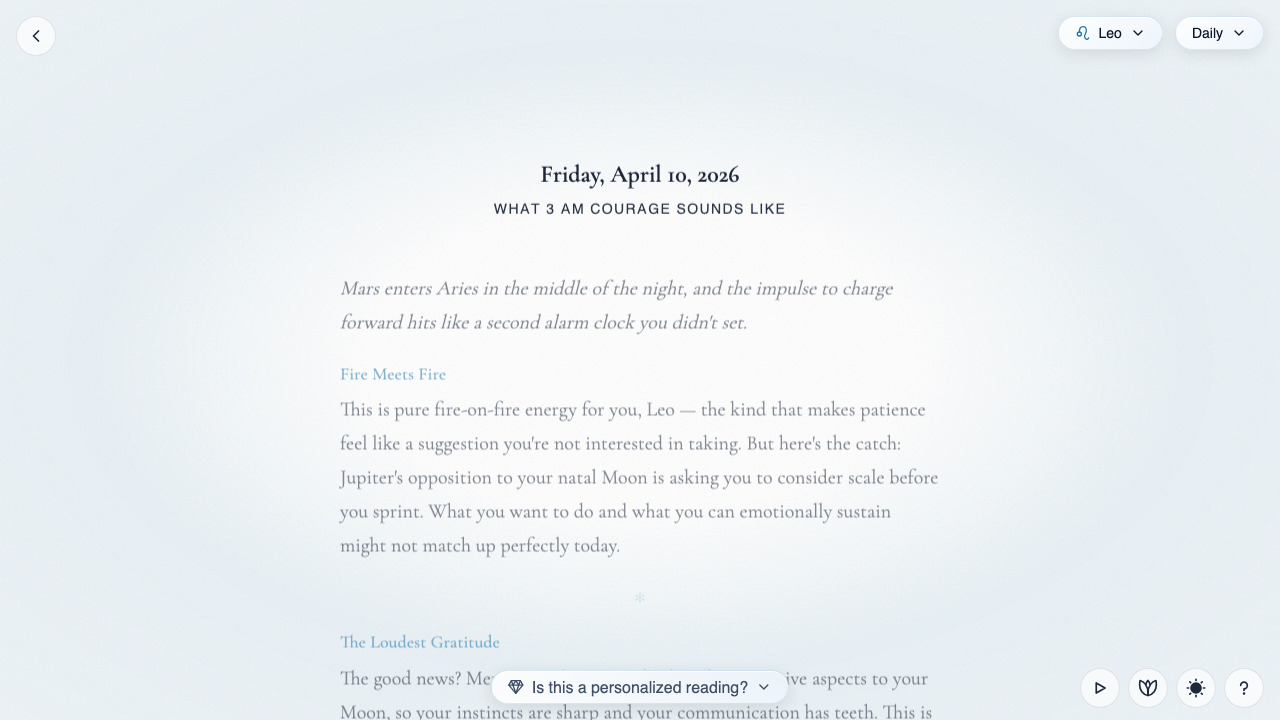
A Closer Look
The uncomfortable implication of the four tests: the only way to properly evaluate any app's personalization is on its paid tier, because that's where personalization lives for almost every app on the market, including ours. So the smart move is to buy one month of whatever you're considering, run the friend-swap test before the second month renews, and cancel and try the next one if the readings match.
If you want to understand what a reading is referencing once you're on a personalized tier, there are 280+ free Learn pages covering signs, planets, houses, aspects, and transits. When your reading mentions Venus in your 7th house, you can tap through and in 30 seconds know what a 7th house is and why Venus there matters.
FAQ
I paid for the premium tier before and got the same generic horoscope as everyone else. How do I know yours is different?
Honest answer: you can't tell from our free tier, because our free tier isn't personalized either -- it's one reading per sign, same as most apps' free versions. The only test that counts is to pay for one month of whichever paid tier you're curious about (ours or a competitor's), run the friend-swap check in the first week, and cancel before renewal if it fails. That's the only promise worth making, and it's one you enforce yourself.
Why would an app collect my birth time if it's not going to use it?
Two reasons. Some use your full chart for decorative features -- a birth chart you can look at, a Rising sign on your profile -- but still write daily readings from your Sun sign because it's cheaper to generate once and serve to millions. Others technically use the full chart but lean so hard on template language that the specificity disappears in the writing. Both feel identical to the reader.
Can AI handle astrology, or is it just making things up?
The planetary positions are real astronomy -- every app uses the same sky data. What matters is what the AI is working from. The better systems are built on a library of actual astrology writing and checked before anything reaches you. The bad ones ask a language model to "write a daily horoscope for a Pisces" and ship whatever comes back. You can usually tell which is which by the second week.
I don't know my exact birth time. Am I stuck with Sun sign readings?
Not stuck, but you lose your Rising sign and house placements, which matter for about a third of what a chart-based reading references. Your Moon, your planetary aspects, and today's transits against them still work fine, and the reading is still far more specific than a Sun sign paragraph. Check a birth certificate or ask a parent if you want the full picture.
The free version of Tailored Moon won't prove anything about personalization -- we're straight about that. What it will give you is the Learn section, journaling, a decision timer, and a daily reading for your sign to start with. When you're ready to pay for chart-based readings -- from us or anyone else -- run the friend-swap test in the first week and cancel before the second month if it fails. That's the whole game.